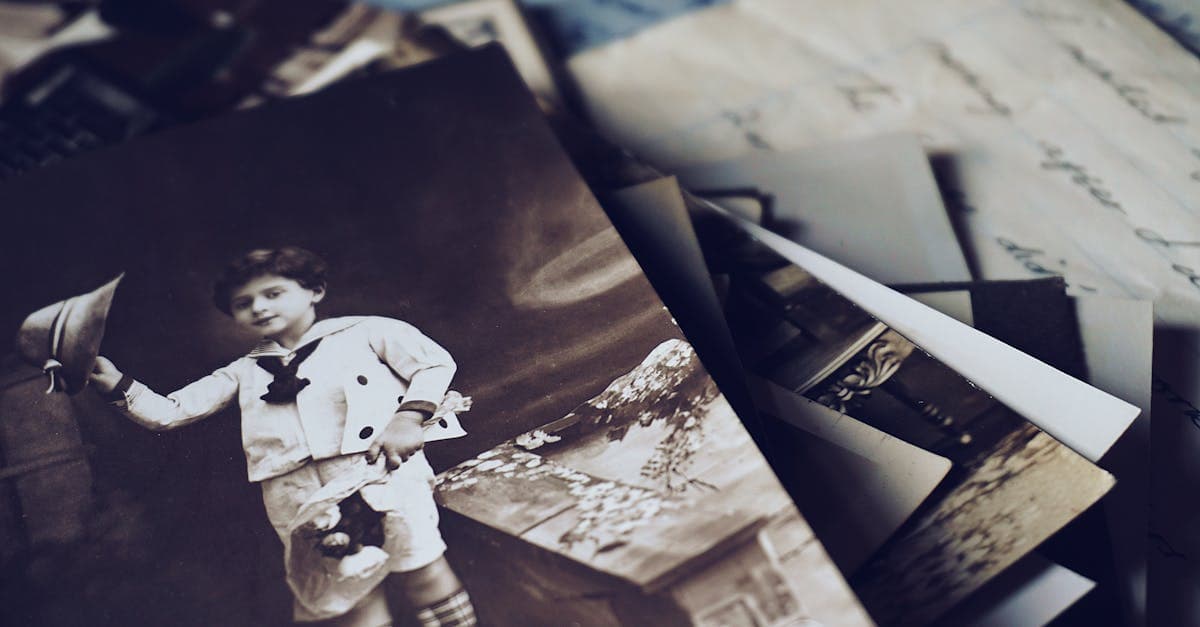
Faded photos are the ones that look washed. Tones have drifted together, highlights and shadows pressed toward the middle, and you can still tell what's in the frame but you're reading it through gauze. Fade is slow, cumulative, and mostly environmental.
What causes fade on old photographs
Two mechanisms, often working in parallel. Light fade happens because photons deliver energy that drives oxidation of the image material — pigment in a color print, silver in a black-and-white. The Library of Congress' "Limiting Light Damage" page is explicit that cumulative light dose, not peak brightness, is what damages photographs, which is why a print left casually in a sunny hallway for thirty years fades dramatically while a print in a box does not (LoC: Limiting Light Damage).
Heat and humidity drive the second mechanism: thermal and chemical fade, where the image silver or dye oxidizes even in the dark. NEDCC's care leaflet puts a number on it — the rate of chemical deterioration of most photographic materials roughly doubles with each 10°F temperature rise (NEDCC 5.3). NPS Conserve-O-Gram 14/4 recommends keeping photographs below 100 lux when displayed and stable, cool environments for storage precisely because both pathways add up (NPS 14/4).
Visually, fade looks like: shrunken tonal range, midtones crowding the histogram center, highlights that never reach white, shadows that never reach black, and in color prints a dominant cast as the most light-sensitive dye layer goes first (magenta fades fastest in most chromogenic prints).
How AI handles fade — and where it can't
Fade is a good match for AI restoration because it tends to be spatially uniform. PhotoFlip's pipeline:
- Rebuilds the tonal curve by estimating where true black and white should sit based on object recognition (skin, sky, paper).
- Handles color prints by inferring per-channel fade rates instead of applying a single global curve.
- Recovers micro-contrast on faces and edges where local contrast was flattened by density loss.
Honest limit: fade that has actually lost image density — not just compressed it — cannot be fully reversed. If the silver is gone, no amount of curve work brings it back. You'll get a cleaner-looking image but the detail wasn't there to begin with. Interesting footnote from NPS conservation guidance: faded prints stored in the dark can sometimes recover a small amount of apparent density as the chemistry relaxes, but you should not count on that — AI recovers what's visible, and the dark storage effect is partial at best.
Example restorations
- Color snapshot in a magnetic album. Heavy magenta cast from selective dye fade. The model corrects the dye-layer imbalance and reconstructs near-neutral tones.
- Sun-faded framed portrait. The half of the image that faced the window has lost contrast; the shadowed half is intact. AI treats it as a gradient correction anchored on the good half.
- Mid-century B&W print. Globally faded silver with a slight warm drift. The model rebuilds contrast and you see faces and textures you hadn't noticed in the original.
How to restore a faded photo
- Scan in 48-bit color if you can — low-contrast sources need bit depth to rebuild cleanly without banding.
- Upload at photoflipai.com/restore. The restore pass handles global fade, local fade, and per-channel fade in one model run.
- For a B&W print that's cleaner after the fade fix, pass it through colorize-black-and-white-photos to add period-appropriate color.
Related: fade is frequently confused with yellowing — yellowing is a color shift, fade is a density loss, and they often co-occur. Exposure-caused fade during capture is a different problem, see exposure-problems. Pricing: pricing. FAQ: faq.
Sources
- NPS Conserve-O-Gram 14/4 "Caring for Photographs: General Guidelines" — confirms light, heat, and humidity drive photographic fade and recommends light levels below 100 lux for vulnerable materials.
- Library of Congress "Limiting Light Damage" — documents cumulative light dose as the main driver of pigment fade in prints and photographs.
- NEDCC 5.3 — explains oxidation-driven fading of silver image particles and how heat doubles the rate of chemical deterioration per 10°F.
More damage types we restore
Restore photos ruined by mold stains. PhotoFlip's AI rebuilds faded tones and removes purple, black, and fuzzy spots left by fungal growth on prints.
Reverse the yellow cast from oxidation and acidic paper. Free AI preview, no signup — recover your photo's true tone in ~30s.

Red-eye comes from flash reflecting off the retina's blood supply. PhotoFlip detects pupils, replaces the red, and preserves catchlight detail.
Creases break the emulsion along a fold line. PhotoFlip reconstructs image data across the crease using context from both sides of the fold.
Ready to restore your photo?
Free preview, no account needed. Download it in full resolution with a free account.
Upload a photo